A race to the patent office
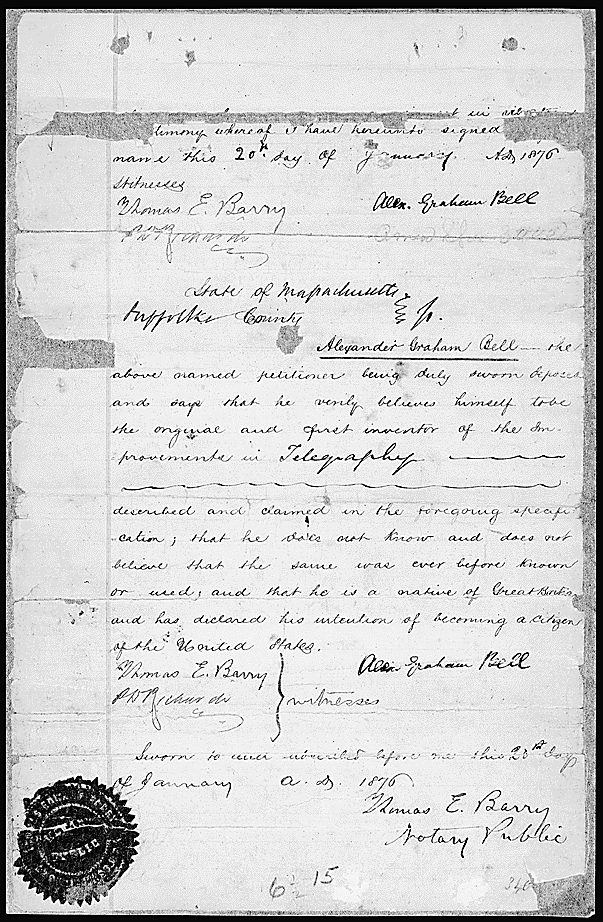
U.S. National Archives (NAID 302052), via Wikimedia Commons. Public domain (U.S. government record).
In March 1876 Alexander Graham Bell filed U.S. Patent No. 174,465, “An improvement in telegraphy.” The same day, Elisha Gray filed a caveat for a very similar invention. Bell won the legal fights that followed (Wondermark, “True Stuff: Alexander Graham Bell vs. Western Union” (drawing on Phil Lapsley’s research)). His backer Gardiner Hubbard had to work hard to persuade people that the telephone was more than a parlour trick (Fortune, 2005).
The memo that never was
The memo says the telephone is “hardly more than a toy” and recommends against buying Bell’s patent. No trace of it turns up in newspapers from 1876 to 1900. It first appeared in print in 1968, in a chairman’s statement in an IEEE journal, pieced together from versions passed around by engineers. A 1976 IEEE Spectrum article already called it “suspect on several counts” (Wondermark, “True Stuff: Alexander Graham Bell vs. Western Union” (drawing on Phil Lapsley’s research)).
The often-quoted line attributed to Western Union president William Orton, that the telephone had “too many shortcomings,” is also shaky (USA Today, 2005 (Kevin Maney)).
The incumbent moved fast and still lost
Bell’s backers did offer Western Union the patents in 1876, reportedly for $100,000, and were turned down (Fortune, 2005). But Western Union didn’t ignore the telephone. It acquired Gray’s competing work, hired Thomas Edison to improve on it and set up its own telephone company, the American Speaking Telephone Company. According to one telecom history, its handset worked better than Bell’s (USA Today, 2005 (Kevin Maney)) (Wondermark, “True Stuff: Alexander Graham Bell vs. Western Union” (drawing on Phil Lapsley’s research)).
Bell sued for patent infringement. By 1879 Western Union had signed an agreement handing the phone business to Bell (USA Today, 2005 (Kevin Maney)). As one columnist put it, Orton didn’t underestimate the phone; he underestimated Bell (USA Today, 2005 (Kevin Maney)).
What the popular version gets wrong
Popular version Western Union wrote a memo calling the telephone a toy.
What the record shows No evidence. The text first surfaces in 1968, and historians consider it fabricated or garbled (Wondermark, “True Stuff: Alexander Graham Bell vs. Western Union” (drawing on Phil Lapsley’s research)).
Popular version The incumbent didn’t see the future.
What the record shows It saw it and competed hard, with Edison’s technology. It lost on patents and law, not vision (USA Today, 2005 (Kevin Maney)).
What it means for today
Today’s incumbents, from telecom operators to cloud giants, aren’t blind to AI either. The question is who controls the key position: patents then, compute, spectrum and edge sites now. See Edge compute.
Companies we own that connect to this story (tickers only, never position sizes):
Sources
- Wondermark, “True Stuff: Alexander Graham Bell vs. Western Union” (drawing on Phil Lapsley’s research)
- USA Today, 2005 (Kevin Maney)
- Fortune, 2005
- Wikimedia Commons, Bell’s telephone patent drawing (NARA 302052)
Last reviewed: 22 Oct 2026. Historical figures are quoted as the sources publish them; where sources disagree, we say so.
Not investment advice. History is a lens, not a forecast. This page is opinion and education, researched and presented with the help of AI analyst personas, and may contain errors. The EarlyConviction team holds positions in NVDA, SPCX, AMZN and may buy or sell at any time. Read the disclaimer.