“Faster horses”: a great line Ford never said
“If I had asked people what they wanted, they would have said faster horses” is quoted in a thousand pitch decks. There is no evidence Henry Ford said it. Quote Investigator traced the idea to a 1999 cruise-industry magazine, where a ship designer said Ford’s customers would “probably” have asked for a faster horse. The line was first put in Ford’s mouth around 2001 (Quote Investigator, 2011) (Snopes, 2025). It isn’t among the authenticated quotations published by The Henry Ford museum (The Henry Ford museum) (Snopes, 2025).
The idea behind it still holds. People rarely ask for a new category before they have seen it. They just didn’t need Ford to say so.
The man with the red flag
Britain’s Locomotive Act of 1865, the so-called Red Flag Act, required mechanically powered road vehicles to have a person walking at least 60 yards ahead carrying a red flag. It limited them to 4 mph in the country and 2 mph in towns (Locomotive Act 1865, legislation.gov.uk). The rules were written for heavy steam traction engines, and early motor cars fell under them too.
In 1896 the Locomotives on Highways Act freed light vehicles from the old rules and allowed speeds of up to 14 mph (Locomotives on Highways Act 1896, legislation.gov.uk). The law caught up only after the technology had already proved itself.
Fifth Avenue, 1900 and 1913
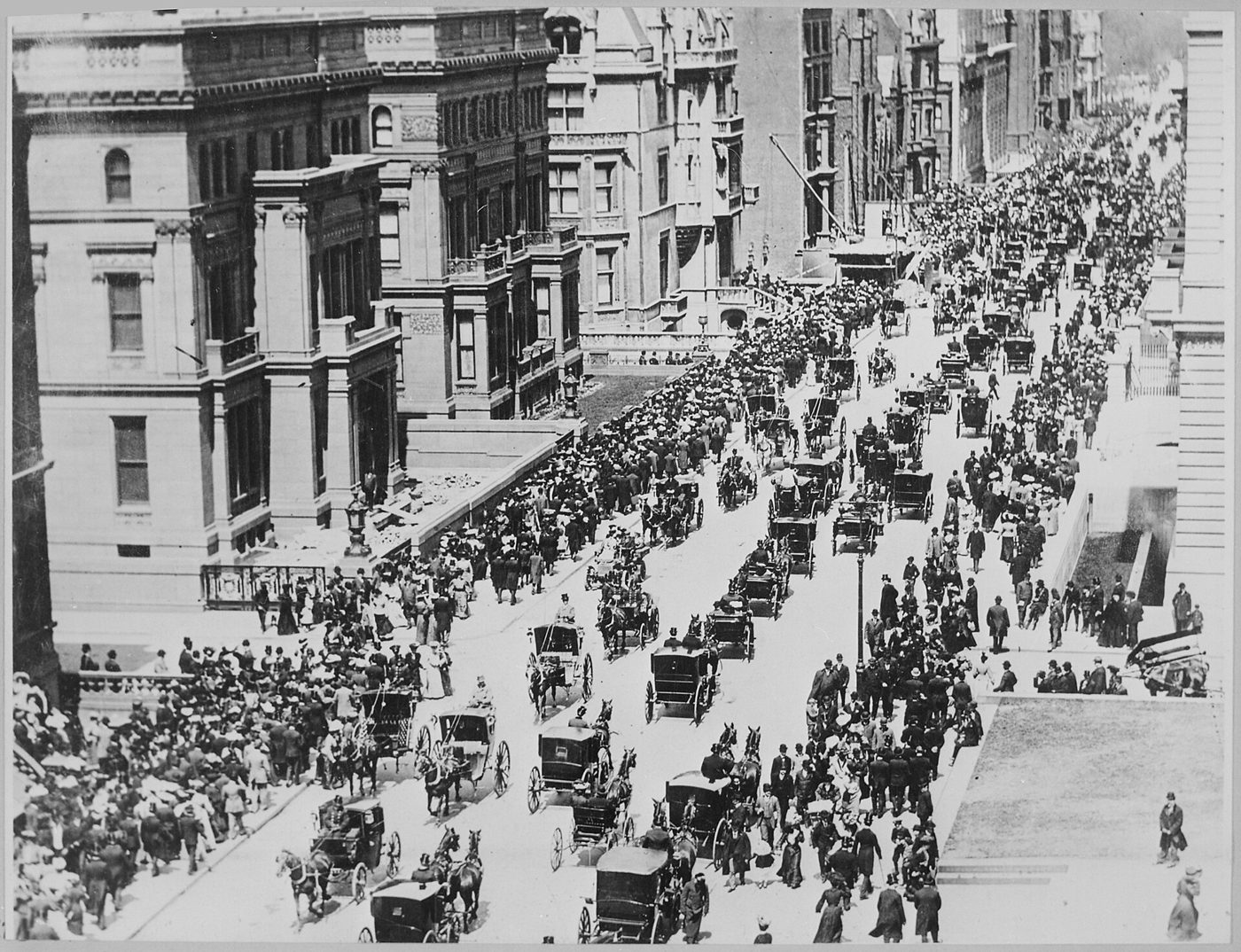
Photo: U.S. Bureau of Public Roads, via the U.S. National Archives (NAID 513360, 30-N-18827). Public domain (U.S. government work).
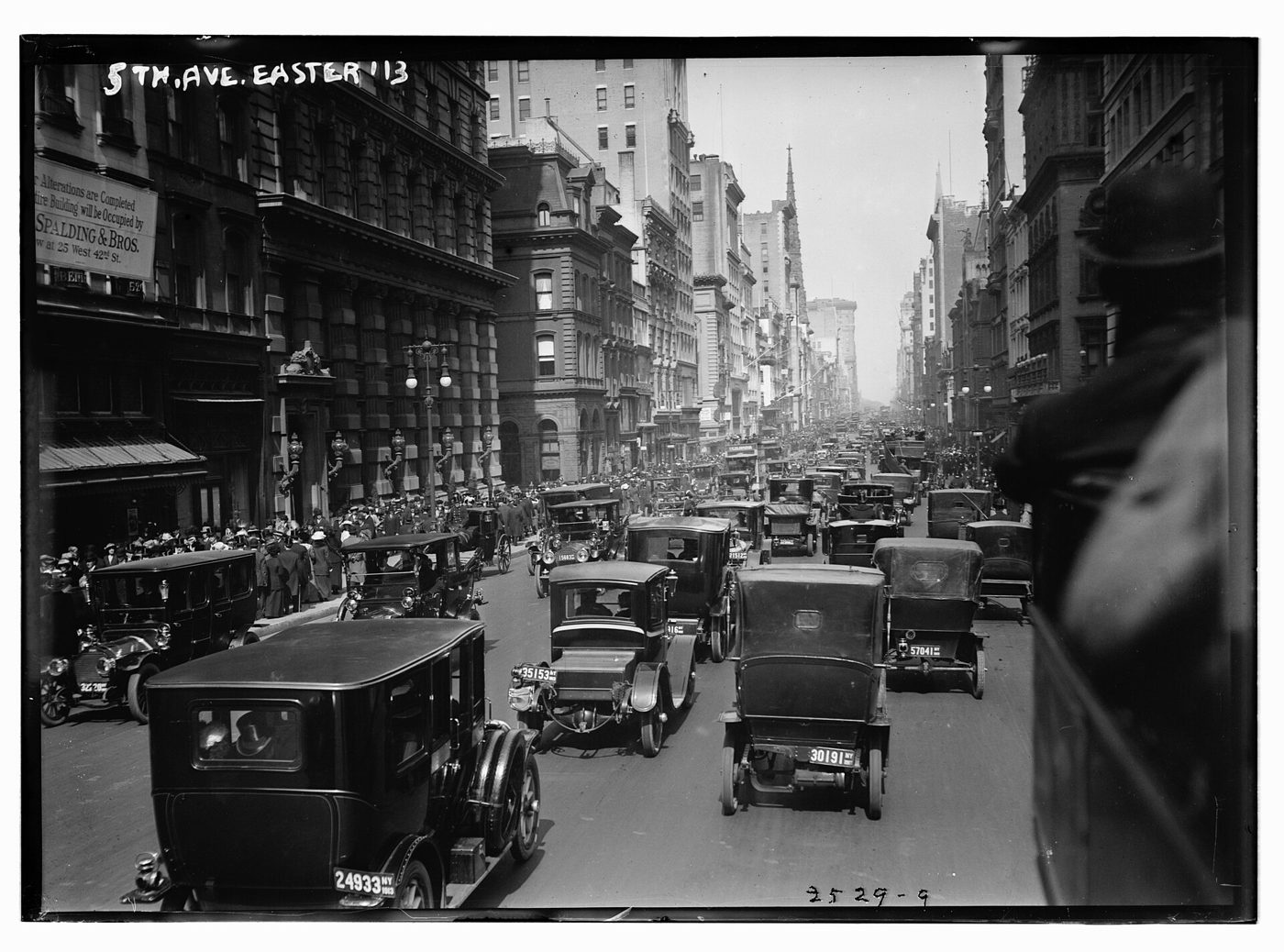
Photo: Bain News Service, via the Library of Congress (LC-DIG-ggbain-11656). No known restrictions on publication.
The two photos make the shift visible: carriages in 1900, motor cars by 1913. Two honest caveats. The original caption of the 1900 photo reads “Note only one auto” (National Archives, Picturing the Century) (National Archives DocsTeach), while the National Archives’ catalog describes “two motor cars” (U.S. National Archives, NAID 513360). And the two pictures were taken from different viewpoints on Fifth Avenue, so they illustrate the change rather than measure it. The exact cross street of the 1913 view isn’t recorded (Library of Congress, LC-DIG-ggbain-11656).
The city data tells the same story. New York had about 128,000 horses in 1910 and about 56,000 in 1920. Horse-drawn passenger vehicles ran in the city until 1918 (NYC Department of Records, 2023).
What the popular version gets wrong
Popular version Henry Ford said customers would have asked for “faster horses.”
What the record shows No evidence he ever said it. The attribution first appears around 2001, decades after his death (Quote Investigator, 2011) (Snopes, 2025).
Popular version Horses disappeared almost overnight.
What the record shows Fast, but not overnight. New York’s horse population fell by more than half between 1910 and 1920, and about 56,000 horses were still working in 1920 (NYC Department of Records, 2023).
Popular version The 1900 photo shows exactly one car.
What the record shows That is what its original caption says, but the National Archives catalog counts two. The 1900 and 1913 photos were also taken from different spots (U.S. National Archives, NAID 513360).
What it means for today
Self-driving cars face the same pattern: rules written for the old technology, fear of the new one, then a fast switch once it is clearly better. See our view of how that plays out in Autonomous cars.
Companies we own that connect to this story (tickers only, never position sizes):
Sources
- Quote Investigator, 2011
- The Henry Ford museum
- Snopes, 2025
- Locomotive Act 1865, legislation.gov.uk
- Locomotives on Highways Act 1896, legislation.gov.uk
- NYC Department of Records, 2023
- U.S. National Archives, NAID 513360
- National Archives DocsTeach
- National Archives, Picturing the Century
- Library of Congress, LC-DIG-ggbain-11656
- Wikimedia Commons file (1900)
- Wikimedia Commons file (1913)
Last reviewed: 22 Oct 2026. Historical figures are quoted as the sources publish them; where sources disagree, we say so.
Not investment advice. History is a lens, not a forecast. This page is opinion and education, researched and presented with the help of AI analyst personas, and may contain errors. The EarlyConviction team holds positions in TSLA, NVDA, AMZN and may buy or sell at any time. Read the disclaimer.