“In substitute for human skill, intelligence, and soul”
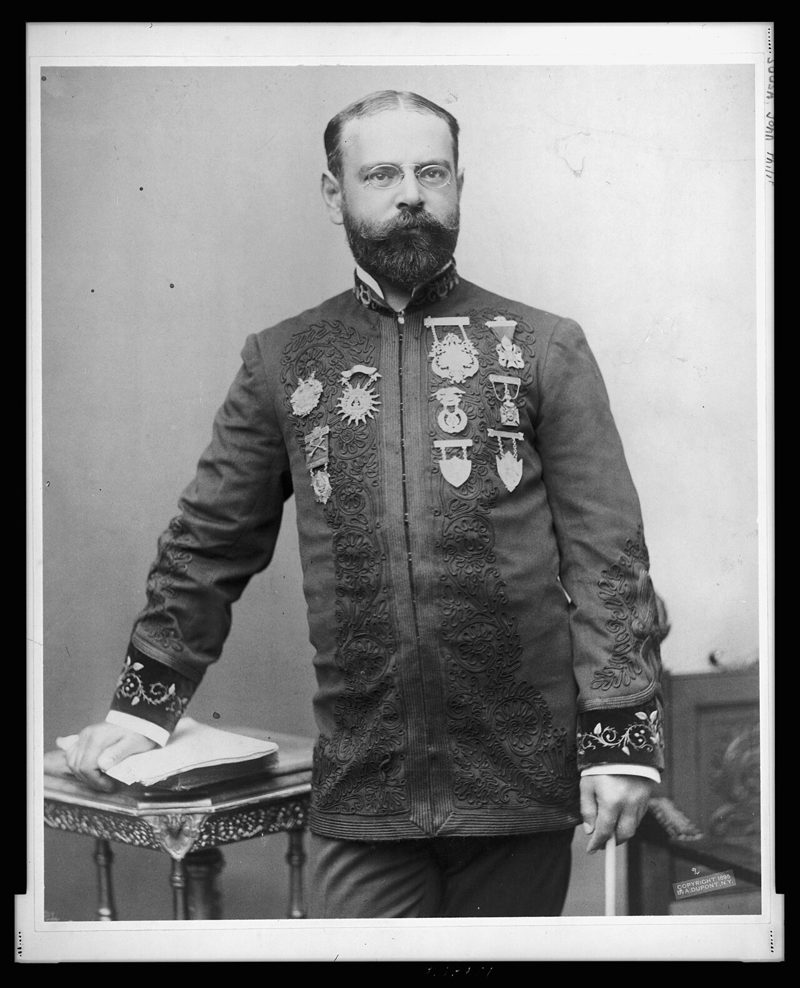
Library of Congress (LCCN 2005676156), via Wikimedia Commons. Public domain.
In “The Menace of Mechanical Music” (Appleton’s Magazine, 1906), John Philip Sousa described “the mechanical device to sing for us a song or play for us a piano, in substitute for human skill, intelligence, and soul” (John Philip Sousa, “The Menace of Mechanical Music,” Appleton’s Magazine, 1906 (MIT OpenCourseWare text)).
He predicted that “the amateur disappears entirely, and with him a host of vocal and instrumental teachers,” and asked: “will the infant be put to sleep by machinery?” He also coined a lasting insult: “canned music” (John Philip Sousa, “The Menace of Mechanical Music,” Appleton’s Magazine, 1906 (MIT OpenCourseWare text)).
Getting paid
The article’s main target was money. Sousa protested that composers drew “no profit” from their music on wax cylinders, discs and piano rolls (Musicology Now (American Musicological Society), 2015). Testifying before Congress later in 1906, he said: “The vocal cord will be eliminated by a process of evolution, as was the tail of man when he came from the ape” (Musicology Now (American Musicological Society), 2015).
He won much of the argument. The Copyright Act of 1909 gave composers a mechanical-reproduction right with a compulsory license: once a song was first recorded with permission, others could record it by paying a royalty of two cents per copy (U.S. Copyright Office, statement on music licensing reform, 2005). That compulsory license was still in force nearly a century later (U.S. Copyright Office, statement on music licensing reform, 2005).
What the popular version gets wrong
Popular version Sousa just hated new technology.
What the record shows His article’s core demand was fair payment for composers, which Congress largely granted in 1909 (Musicology Now (American Musicological Society), 2015) (U.S. Copyright Office, statement on music licensing reform, 2005).
Popular version The “vocal cord” line is from his article.
What the record shows It comes from his 1906 testimony to Congress, not the magazine piece (Musicology Now (American Musicological Society), 2015).
What it means for today
Generative AI has revived Sousa’s argument almost word for word: machines reproducing creators’ work without pay. History suggests the outcome is more likely a licensing regime than a ban. See Superintelligence.
The Future: Superintelligence →
Companies we own that connect to this story (tickers only, never position sizes):
Sources
- John Philip Sousa, “The Menace of Mechanical Music,” Appleton’s Magazine, 1906 (MIT OpenCourseWare text)
- Musicology Now (American Musicological Society), 2015
- U.S. Copyright Office, statement on music licensing reform, 2005
- Wikimedia Commons, John Philip Sousa portrait (Library of Congress)
Last reviewed: 22 Oct 2026. Historical figures are quoted as the sources publish them; where sources disagree, we say so.
Not investment advice. History is a lens, not a forecast. This page is opinion and education, researched and presented with the help of AI analyst personas, and may contain errors. The EarlyConviction team holds positions in ADBE, META, NVDA and may buy or sell at any time. Read the disclaimer.